WhatsApp and social media are not dead. Cheap mass messaging without permission, context, or a clear next step is losing its power.
Brands still need channels where people can discover them. They also need places to answer questions, continue conversations, and maintain relationships. The problem starts when one channel must do every job.
RCS adds verified branding, rich media, buttons, and interaction data to mobile messaging. It does not remove the core risk. An unwanted message can still cause filtering, blocking, spam reports, and customer fatigue.
The 75% figure shows intent, not guaranteed results
The Twilio 2025 State of Customer Engagement reports that 75% of surveyed business leaders planned to invest in RCS during 2025. The survey covered 637 business leaders and 7,640 consumers across 18 countries. Twilio collected responses from January 3 to February 17, 2025.
This result measures investment intent within the survey population. It does not prove that RCS always increases sales. Results still depend on consent, segmentation, message content, send time, data integration, and the experience after a customer taps.
Twilio also reports that 71% of consumers abandon irrelevant experiences. Rich media can increase the value of a relevant message. The same media can also increase the disruption caused by the wrong message.
Social media remains a discovery channel
DataReportal Digital 2026 Indonesia estimates that Indonesia had 230 million internet users in October 2025. The report also records 180 million social media user identities. User identities do not always equal unique people.
Globally, DataReportal Digital 2026 identifies search engines as the leading brand discovery source for connected adults. People used social media on an average of 4.21 days each week. Both channels still support discovery.
Deloitte Digital Media Trends 2025 reports that 56% of Gen Z and 43% of millennial respondents in the United States find social content more relevant than television and film. A United States survey does not directly describe Indonesia. It still shows how creators and social platforms can build relevance.
A follower is not an owned customer record. A platform controls distribution, formats, policies, and data access. Use social media for discovery. Move valuable relationships to channels with recorded consent and history.
Give each channel one clear job
A sound architecture separates discovery, conversation, continuity, retention, and consent records. This separation reduces repetition. It also lets teams choose a channel that matches each customer need.
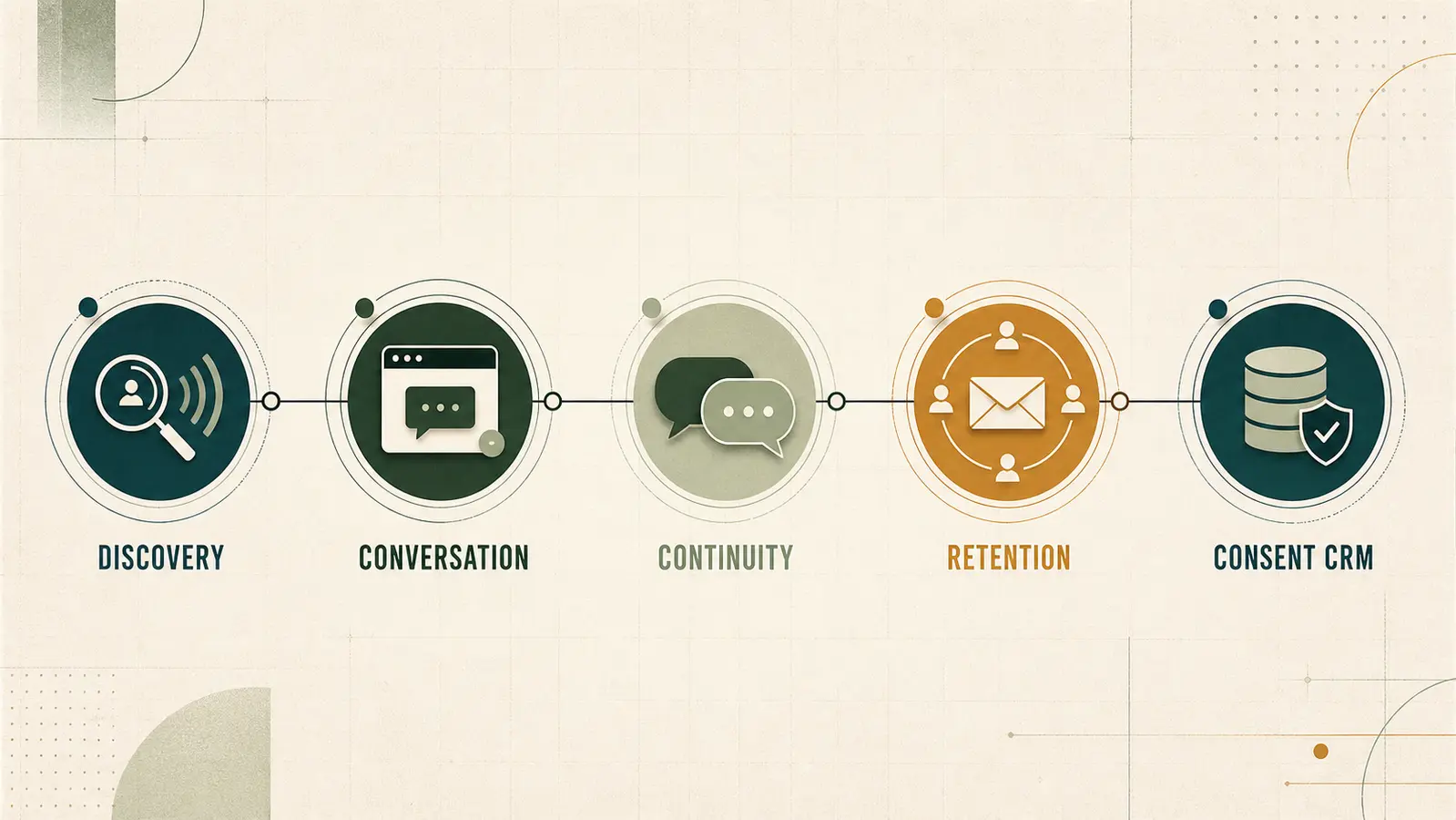
| Layer | Primary channel | Job | Limit |
|---|---|---|---|
| Discovery | Social, creators, and search | Help people discover a problem, category, and brand. | Platform distribution can change. |
| Conversation | Website and live chat | Handle complex needs with page context. | Requires a fast response and human path. |
| Continuity | WhatsApp and RCS | Send important messages and requested follow-ups. | Requires consent, frequency control, and relevance. |
| Retention | Email and owned communities | Maintain relationships that customers chose. | Provide preference and unsubscribe controls. |
| Data source | CRM | Store consent, preferences, lead owners, and history. | Limit access and retention by purpose. |
WhatsApp remains useful when brands respect permission
The WhatsApp Business Messaging Policy requires a business to receive a phone number and opt-in permission before contacting a person. A business must also honor requests to stop, block, or opt out.
On the WhatsApp Business Platform, a business can only start conversations with an approved message template. Free-form replies apply within the 24-hour service window after the user's latest message. The policy also requires clear escalation paths when a business uses automation.
These rules connect each message to a customer request. Confirmations, schedule changes, order status messages, and requested follow-ups have a clear purpose. Repeated promotions without context do not have the same basis.
WhatsApp Business Platform pricing also varies by category, country, and current Meta terms. Treat cost and policy as operating data. Do not put a fixed price assumption into the business model.
RCS provides a new format, not new permission
RCS can show a verified brand name, images, cards, quick replies, and action buttons. These features can support confirmations, delivery updates, repeat orders, and short service actions.
Do not move an old broadcast list into RCS only because the format is new. Better buttons cannot restore trust when a customer does not recognize the message context. The brand still needs provable opt-in, an opt-out path, frequency limits, and a suitable fallback.
Start with one transactional use case. Compare it with an existing SMS or WhatsApp flow. Do not start with a mass campaign only because the medium is new.
Email follows the same permission discipline
The Google Gmail sender guidelines tell senders to keep the Postmaster Tools spam rate below 0.1%. Google tells senders to avoid a rate of 0.3% or higher. Marketing messages from bulk senders must also support one-click unsubscribe.
The lesson is consistent. Delivery infrastructure cannot replace recipient intent. A brand must know who requested a message, which topic they selected, and when their permission changed.
Use the CRM as the source of consent and context
A CRM must store more than a name and phone number. It must record the consent source, time, purpose, channel, status, and preference changes. Each outbound message must connect to that record.
The Salesforce State of the AI Connected Customer includes 15,015 consumers and 1,570 business buyers across 18 countries. Only 49% said that companies used their information in ways that benefited them. Another 71% said they were becoming more protective of personal information.
This data supports a practical decision. Personalization must provide visible value. A CRM that only sends more promotions increases volume without increasing value.
Measure resolved conversations, not brand appearances
Impressions still measure distribution. They cannot serve as the primary KPI for a conversation system. Teams must measure value, operating load, and trust impact.
| KPI | Calculation | Decision |
|---|---|---|
| Cost per resolved conversation | Total channel and operating cost divided by resolved conversations. | Compare efficiency without rewarding empty volume. |
| Conversion per message | Attributed conversions divided by delivered messages. | Assess message relevance and segmentation quality. |
| Blocks, opt-outs, and spam reports | Negative signals divided by sent or delivered messages. | Stop a harmful frequency, segment, or message. |
| Response time | Median time from an inbound message to a useful reply. | Set automation and human capacity. |
| Retention after contact | Customers who remain active after a defined period. | Check the long-term effect of communication. |
Set a baseline for each KPI. Separate transactional, service, and marketing messages. One combined number can hide a problem within one category.
A 30-day implementation plan
- Week 1: map every entry point, channel, template, and consent source.
- Week 2: connect customer identity, preferences, and history in the CRM.
- Week 3: test one high-value flow, such as consultation, scheduling, or order status.
- Week 4: measure outcomes, negative signals, response time, and retention.
Remove lists without a valid permission basis. Separate promotions from service messages. Provide a human path for complex conversations. Record every consent change as an auditable event.
Verdict
- The WhatsApp era is not over. The cheap WhatsApp spam era is starting to end.
- The social media era is not over. Followers and organic reach are not guaranteed assets.
- RCS enriches a message. It does not repair a strategy that ignores permission.
- The winner will not appear most often. The winner will deserve permission to appear.
If your channel data remains separate, start with a Data Health Audit. If tracking already exists, use the Attribution Bridge to connect messages, leads, and business outcomes.
Primary sources
- Twilio, 2025 State of Customer Engagement
- DataReportal, Digital 2026 Indonesia
- DataReportal, Digital 2026 Global Overview Report
- WhatsApp Business Messaging Policy
- Meta, WhatsApp Business Platform pricing
- Google, Gmail sender guidelines
- Salesforce, State of the AI Connected Customer
- Deloitte, 2025 Digital Media Trends